
Bank On Freedom: Business Owners Blog
How To Turn Business Cash Flow Into Long-Term Freedom
Most business owners are so focused on keeping revenue coming in, putting out daily fires, and taking care of their teams that their personal freedom strategy stays perpetually “for later.” This article walks through how to turn today’s cash flow into tomorrow’s freedom without starving the business in the process.

You're Winning the Game. But Losing the Money.
As a business owner, you've mastered the art of making money. You've built systems, hired teams, and created revenue streams that most people only dream about. But here's the uncomfortable truth: the money you're making is being systematically drained away. Every time you take out a business loan, you're paying interest to a bank. Every time you need working capital, you're either draining your reserves or taking on debt. Every time a key employee leaves, you're absorbing massive turnover costs. And every year, taxes eat away at your profits. The math is staggering. A business owner making $100,000 in annual profit typically loses:
$20,000 to bank interest
$15,000 to idle cash (opportunity cost)
$25,000 to employee turnover
$20,000 to tax inefficiency
$20,000 to missed opportunities
That leaves you with just $20,000 of the $100,000 you worked so hard to earn.
A Father-Daughter Business Put To The Test
My name is David Saucer, and for the last several years I have had the rare privilege and real pressure of building a business alongside my daughter. The hardest part has never been the numbers on a spreadsheet. It has been learning how to lead together without losing what matters most between us.
When you go into business with your child, you are running two experiments at once. One is whether the business model will stand on its own. The other is whether your relationship can carry the weight of payroll, risk, and constant decision-making. I was determined not to sacrifice either one on the altar of the other.
My daughter is sharp, independent, and more willing to step into uncertainty than I was at her age. That courage makes her a powerful partner. It also means she sees opportunities everywhere and wants to move fast. I have more scars from previous cycles, so I naturally see the risks first. Neither of us is wrong, but that difference can create real friction if you do not have the right structure around it.
On any given week, a key hire or a promising opportunity can disappear in a day. Competitors dangle flexible schedules, stock options, and a shinier story about the future. It is easy to get pulled into a reactive cycle where every email feels urgent and every decision feels like a referendum on whether you are keeping up.
What I saw, both in our business and in the owners I work with, is that if you operate that way for long enough, you slowly build your entire world around everyone else’s timeline and demands. The bank’s appetite for risk. The market’s current mood. The talent market’s latest trend. Very little of it is built around your own definition of freedom. Even the so-called winners end up exhausted.
I did not want that for my daughter or for our team. The only way I knew to refuse that kind of constant reaction was to build a framework that told us, in advance, how we would convert ordinary business cash flow into long-term freedom. That framework is what I now call Bank On Freedom, and it reshaped how we worked together as father and daughter.
The Real Tension In A Family Partnership
Most people assume the great danger of working with your child is mixing family and money. In my experience, the deeper strain is more subtle. As a father, every instinct in me wants to absorb the hardest blows so she does not have to. As a partner, I know the only way she grows into the leader she is capable of becoming is by carrying real responsibility and real risk.
In the early stages of the business, that tension showed up in every planning meeting. She pushed for aggressive reinvestment in marketing, people, and systems. I wanted more margin and more reserves. We both cared about the same end state—freedom for our family and for the people who trusted us—but we were playing different roles in the story and reading from different scoreboards.
It finally clicked for me that the conflict was not about who was right. It was about how we were measuring progress. If the only way she could tell I trusted her was how quickly I said yes to spending money, then every budget conversation felt like a test of our relationship. If the only way I could tell the business was secure was a certain number in the bank account, then every bold move felt like a direct threat to our future.
The solution was not choosing one of us to win more often. The solution was designing a system that protected the business, honored our relationship, and translated both of our goals into a written plan we could see and revisit together.
Where Standard Advice Broke Down
Before Bank On Freedom, we walked through the same maze of advice most owners are handed. The first stop was the traditional retirement path: fund a 401(k), add a modest match, lock the money away, and cross your fingers that the market behaves. On paper, it looked responsible. In reality, it did almost nothing for the questions that were keeping us up at night—lumpy cash flow, key hires, and the need for flexible capital when opportunities showed up on a Tuesday afternoon.
Then came the sophisticated compensation ideas: deferred comp plans, elaborate vesting schedules, and documents thick enough to use as doorstops. They may work for large corporations with whole departments dedicated to administering them, but in a growing, family-led business they created more fog than clarity. We found ourselves spending energy decoding the plan instead of directing energy toward the mission.
There was a pattern. Almost every traditional strategy forced a trade: protect the business or reward the people. Play it safe or invest in the team. My daughter and I needed a structure that did not split those priorities apart. We needed a way to protect downside, build real ownership for her over time, and still keep capital available for the decisions that actually move a business forward.
- Protection for the business if growth did not follow the neat curve on the spreadsheet.
- A concrete, written path for my daughter to earn meaningful ownership over time.
- Access to capital we controlled, without waiting on a bank’s approval or changing terms.
- A way to reward the people building with us without turning every conversation into a bidding war.
That search is what led us to formalize the Bank On Freedom framework and apply it inside our own story, not just in the lives of the owners I advise.
Designing Our Father-Daughter Freedom Plan
At its core, Bank On Freedom is the deliberate use of specially structured, cash-focused life insurance contracts to give owners a private, contractually guaranteed cash pool that they control, and then coordinating that pool with the real risks and opportunities in the business. For us, that concept became the backbone of what I now call our Father-Daughter Freedom Plan.
We started by agreeing, in writing, that a defined percentage of profit would always be directed into that private cash pool. It was not “extra” money that might or might not be there at the end of the quarter. It was part of the plan, just as real as payroll or rent, designed to show up year after year regardless of how busy the inbox became.
Next, we made that pool our shared decision-making table. Every major move—a leader we wanted to hire, a new initiative we were excited about, a piece of equipment that would increase capacity—had to be viewed through a simple question: does this strengthen or weaken our long-term freedom? That language shifted the conversation from, “Are you being too aggressive or am I being too cautious?” to, “What does this do to the freedom we have already committed to build?”
We also rewired how my daughter’s compensation and future ownership would work. Instead of vague promises about “someday” equity, we mapped out specific milestones—years of service, revenue targets, and leadership responsibilities she wanted to grow into—and tied them to clear steps in gaining more of the business over time.
Alongside that, we designed a parallel track for key team members. They could see, on paper, how their contribution connected to long-term benefits instead of hearing another vague speech about “being part of the family.” The same pool of capital that protected the business and supported our ownership transition could also be used to reward the people who chose to build with us.
- We funneled a fixed slice of profit into a private, contractually guaranteed cash pool instead of leaving it as idle operating cash.
- We used that pool as our neutral ground for big decisions, filtering every hire and project through the lens of long-term freedom.
- We tied my daughter’s compensation and ownership path to written milestones she helped define and was eager to grow into.
- We created a parallel structure for key team members so they could see a future with their name on it, not just a paycheck.
The effect of that structure was profound. Hard conversations became less personal and more principled. When my daughter wanted to take a swing at a bold idea, we did not have to relitigate our personalities. We went back to the policies, priorities, and promises we had already agreed on together.
She gained the freedom to lead, experiment, and occasionally fail inside guardrails that protected the business and our relationship. I gained the confidence that, regardless of what the market threw at us, we were building an asset that carried multiple jobs at once: protecting the family, backing the business, and honoring the people who chose to link their future to ours.
The Quiet Win Of Building With Your Child
The most meaningful result of all this does not live in a spreadsheet. It lives in the way my daughter and I sit across from each other today. We still have different instincts. We still see risk and opportunity through different lenses. But instead of those differences pulling us apart, they now serve the same mission we chose together.
She knows exactly how the work she does this quarter translates into freedom for her future family. I know exactly how our capital is being deployed behind the scenes to create options that most owners never get to see. The scoreboard is shared, and so is the story we are writing.
If you are a father or mother building a business with your son or daughter, here is what I would tell you from the other side of some hard conversations: do not settle for plans that only protect numbers and ignore relationships. Build a system that lets you look each other in the eye years from now and say, “We did this the right way, and we are still proud to sit at the same table.”
For our family, that is what Bank On Freedom has become. It is more than a financial strategy. It is a way of honoring the people we love most while we steward the capital and opportunities we have been given.
The Hidden Financial Strain On Business Owners
If you are like most owners, your wealth is tied up in the business: inventory, payroll, growth projects, equipment, and the constant need for “just a little more” cash to keep things moving. Traditional advice tells you to pull money out and put it into retirement accounts or generic investment products, but that often ignores how your business actually works day-to-day.
The result is a constant tension between what the business needs now and what you know you should be doing for your future. Cash that could be working strategically for you gets trapped in checking accounts, sporadic investments, or reactive decisions. Meanwhile, your personal freedom date keeps drifting further out.
Revenue is up, but you still feel cash-poor personally.
You hesitate to commit to growth because you are unsure about liquidity.
You worry that one bad quarter could undo years of work.
Your personal plan feels like an afterthought to the business.
The Bank On Freedom Framework
Bank On Freedom is a strategy-first approach built specifically for business owners. Instead of forcing your world into a traditional financial planning box, it starts with how cash actually moves through your company and connects that flow to a long-term freedom plan you can understand and execute.
Core Pillars Of The Framework
Clarify what freedom actually looks like for you as an owner, not just a generic retirement number.
Design a private, owner-controlled cash reserve that supports both the business and your personal timeline.
Redirect existing cash flow intentionally instead of relying on last-minute windfalls or sporadic distributions.
Integrate tax, risk management, and exit planning so they work together instead of in silos.
The goal is simple: turn the stress and uncertainty of business cash demands into a clear, repeatable path toward personal freedom—without starving your company of the capital it needs to grow.
Your Private
Cash Residence As An Owner
One way to think about the Bank On Freedom approach is as a “CA$H Residence” for business owners—a structured place for your capital to live that is safe, accessible, and purpose-built around your priorities. Instead of leaving excess cash scattered across accounts or locked in inflexible products, you intentionally route it through a design that supports liquidity, growth, and eventual exit.
This is not about chasing the hottest investment idea. It is about building a stable, owner-controlled system that can fund opportunities, weather downturns, and ultimately give you the option to step back on your terms.
A Case-Style Look At Turning Cash-Heavy Risk Into Freedom
Consider a mid-sized owner who was carrying large cash balances to feel “safe” while also juggling expansion, key hires, and personal goals. On paper, the business looked strong. In reality, cash was fragmented, returns were inconsistent, and there was no clear path to personal freedom.
Working through the Bank On Freedom framework, we helped them consolidate and redesign how cash moved through the company. Instead of passive balances, capital began to flow through a coordinated structure that supported both daily operations and long-term priorities.
Created an intentional owner cash reserve that matched real-world volatility instead of arbitrary rules.
Aligned distributions and reinvestment with a defined personal freedom date.
Reduced anxiety around “what if” scenarios by integrating risk management and liquidity planning.
Turned idle cash into a strategic engine for both growth and eventual exit.

We will send you the free Guide!
How This Bank On Freedom Graphic Works
This visual maps how business cash flow can be redirected with intention, moving from day-to-day operational demands into a structured strategy that builds long-term optionality for the owner. It shows the connection between enterprise cash, protected reserves, and ultimately the personal freedom outcomes you are working toward.
Each main band represents a different layer of the framework, from business operations to owner-level strategy.
Cash enters at the business level, then moves through intentional buckets that protect, grow, and reposition it over time.
The flow helps you see how today’s cash realities can be translated into a clear path toward future freedom outcomes.
You can return to this graphic as a reference point throughout the article to orient where your current situation sits within the framework and to clarify which strategic moves are most relevant for you right now.
The Talent Retention Game-Changer: Stop Losing Top Talent. Start Building Their Future.
Top talent has options. When competitors can copy your pricing or product, the real advantage becomes the team that chooses to stay and build with you. Yet many owners rely only on salary and basic benefits to keep their best people.
Using the Bank On Freedom approach, owners can carve out meaningful, performance-aligned retention strategies—without giving away permanent equity or creating unsustainable cash commitments.

Here's a problem most business owners face but rarely talk about: retaining key employees costs a fortune.
When you lose a top performer, you lose:
• Institutional knowledge
• Client relationships
• Team morale
• Productivity (while you search for a replacement)
• Training costs for the new hire
The traditional solution? Pay more. But that's a losing game. You can't out-salary your competitors forever.
The real solution? Give them something no competitor can match: a future with their name on it.
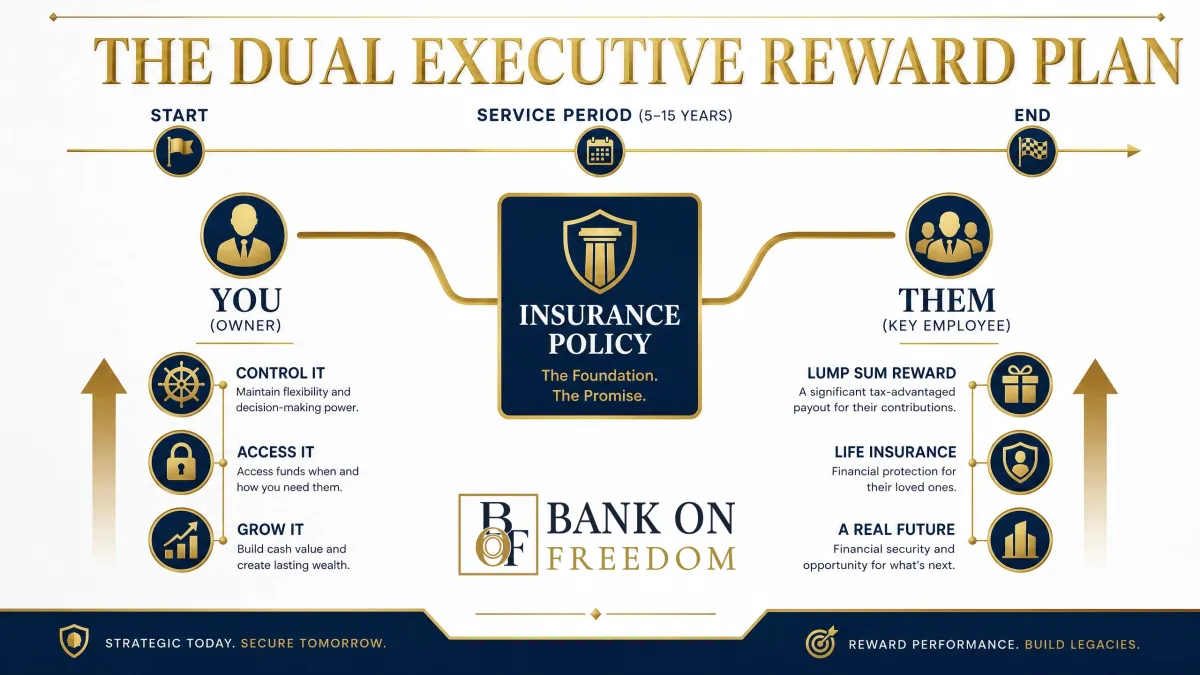
The Dual Executive Reward Plan uses the CA$H Residence framework to create a retention strategy that benefits both you and your key employees:
For the Employee:
Guaranteed growth on their reward
A lump sum at retirement or departure
Life insurance protection for their family
A tangible future they can count on
For the Owner:
The capital you allocate for the reward stays on your balance sheet, growing tax- deferred
You can borrow against the policy for business needs
You're not "spending" money on retention; you're repositioning money you already have
The same capital builds your wealth while retaining your people
The Math: Instead of paying $50,000 in bonuses that disappear, you structure a Dual Executive Reward Plan. Over 5 years, you allocate $50,000, but that capital grows guaranteed, stays accessible to you, and builds your wealth while securing your top talent.
Owner Outcomes And Strategic Advantages
When you design around how your business truly operates, the benefits compound over time. Instead of relying on hope, assumptions, or last-minute decisions, you can see how today’s cash flow is building tomorrow’s freedom—and adjust as reality changes.
Greater confidence making growth and hiring decisions because your personal path is clear.
Reduced dependence on a single exit event to fund your future.
Improved ability to weather downturns without derailing long-term goals.
Stronger alignment between your vision, your team, and the financial engine of the business.
Ultimately, Bank On Freedom is about reclaiming control—over your time, your options, and the legacy you want your work to create.
Ready To Bank On Your Freedom?
If this article resonates, the next step is to see how the Bank On Freedom framework could apply inside your world—your margins, your team, your goals. A focused strategy conversation can help you clarify what freedom looks like and what it will take to get there.
Or, if you prefer to keep exploring, the Freedom Library offers more owner-focused articles, tools, and case-style breakdowns to help you design a path from cash-flow-dependent to genuinely free.
The business owners who are winning in 2026 aren't just making more money.
They're keeping more money. They're building systems that work for them, not against them.
Your competition is already using these strategies.
The question is: how much longer will you wait?
Start your journey to financial sovereignty today.

How To Turn Business Cash Flow Into Long-Term Freedom Capital
See how to systematically redirect excess cash flow into an owner-centric freedom reserve without starving your business of working capital.
Designing Executive Benefits That Actually Retain Your Best People
Learn how to structure retention-focused benefits so top performers have real reasons to stay beyond just salary and bonuses.
Avoiding The 3 Most Common Exit Planning Traps
Explore the hidden pitfalls that quietly erode owner value during an exit and how to start de-risking years in advance.
COMPANY
LEGAL
SOCIALS
Copyright 2026. Bank On Freedom. All Rights Reserved.