
The Infinite Banking Concept
Become Your Own Banker
In Becoming Your Own Banker, R. Nelson Nash introduced a paradigm shift: stop thinking of yourself as a borrower and start thinking of yourself as a banker. It's a complete re-imagining of how money moves through your life.
The Core Insight
Every Purchase Has an Interest Cost
Nash's foundational observation is simple yet profound:
every purchase you make has an interest cost. You either
pay interest to a bank, or you forfeit the interest you could
have earned by spending your own cash. There is no escaping
the banking function—the only question is whether you control it
or someone else does.
The Mechanics of Privatized Banking
Capitalize Your Own Bank
Over-fund a high-cash-value dividend-paying Whole Life insurance policy from a mutual company. This policy becomes your personal banking platform—structured by a specialist for capital efficiency, not death benefit maximization.
Your Capital Compounds Uninterrupted
Once funded, your capital grows on a guaranteed, tax-free basis. Unlike retirement accounts, this growth is not subject to market volatility. When you take a policy loan, your cash value doesn't leave the account—it stays, continuing to earn dividends on the full amount.
Borrow Against—Never Withdraw From—Your Capital
When you need capital, you borrow against the policy via a policy loan. The critical distinction: you're borrowing the insurance company's money while your money continues to compound as if untouched.
Repay Yourself Like an Honest Banker
Pay yourself back at the same market rate you would have paid a bank. This isn't optional—Nash calls it 'being an honest banker.' Each repayment cycle restores borrowing capacity and perpetuates the growth.
Build Generational Wealth Architecture
Over time, this system creates a self-sustaining wealth engine. You're not just accumulating assets—you're building a legacy structure that can be passed to heirs, funded with tax-efficient capital, and managed with strategic discipline.
The $50,000 Truck
Nash uses equipment financing to show how a business owner can reclaim the interest they would otherwise pay to a third-party lender.
The Traditional Way
- Bank lends $50,000 at 8% interest
- Monthly payments for 4 years
- You own a depreciated truck; the bank owns all the interest profit
- Every 4 years you "reset" to zero
The IBC Way
- Pay premiums into your policy (capitalize your bank)
- Take a policy loan for the truck—your cash value stays and grows
- Repay yourself at market rate (8%)—recover principal + interest
- Your "bank" grows larger with every cycle
Side-by-Side Comparison
| FEATURE | BANK METHOD | IBC METHOD |
|---|---|---|
| Out-of-Pocket Cost | $1,220 / month | $1,220 / month |
| Who Gets the Interest? | The Bank | You (via Policy Growth) |
| Collateral | The Truck | Your Cash Value |
| Ending Cash Position | $0 (after each truck is paid) | Increasing Capital |
Three Wins From Every Purchase
Nash points out that by using this method, you achieve three things simultaneously.
The Equipment
You still get the truck (or car, or equipment) you need to run your business or live your life.
The Recovery
You recover the interest that usually leaks out of your life to the banking industry. That money stays in your system.
The Death Benefit
Because this is a life insurance policy, you're building a massive, tax-free legacy for your heirs as a 'side effect' of financing.
The 5 Core Principles of IBC
Think Long-Term
Look at finances through a generational lens. The power of IBC comes from uninterrupted compound growth over years and decades.
Don't Be Afraid to Capitalize
A bank cannot lend money it doesn't have. The more capital you put into your system, the more robust your 'bank' becomes.
Don't Steal from the Banker
If you borrow from your policy, you must pay yourself back with interest. Skipping repayment depletes your future growth—Nash calls it 'stealing from yourself.'
Stop Banking with Others
Recapture the interest you're currently paying to third-party lenders. Keep principal and interest within your own financial ecosystem.
Rethink Your Thinking
The biggest obstacle is the mental block from traditional financial education. Move from 'saving vs. spending' to 'controlling the banking function.'
Traditional Strategy vs. Control-Based Strategy
This isn't about 'better returns.' It's about fundamentally different financial architecture.
| FEATURE | TRADITIONAL STRATEGY | CONTROL-BASED STRATEGY |
|---|---|---|
| Liquidity | Locked until 59½ with penalties | Accessible anytime via policy loans |
| Tax Treatment | Tax-deferred; taxed on withdrawal | Tax-free growth and tax-free access |
| Contribution Limits | Annual caps ($22.5K–$66K) | No contribution limits |
| Compounding | Interrupted when funds are withdrawn | Uninterrupted—grows even when borrowed against |
| Control | Managed by institutions and advisors | You own and direct every decision |
| Wealth Transfer | Subject to probate and estate taxes | Tax-free transfer to beneficiaries |
| Market Risk | Fully exposed to market volatility | Guaranteed growth with contractual floor |
"Don't Steal the Peas"
One of Nash's most powerful teachings uses a simple grocery store analogy to reveal how most people unknowingly erode their own wealth.
The Grocery Store Owner
Imagine you own a thriving grocery store. You invested significant capital—prime location, inventory, employees, overhead. As the owner, you might think it's harmless to grab a can of peas off the shelf now and then. It's your store, after all.
But here's the math: each can costs you 57 cents wholesale and sells for 60 cents. That's a 3-cent margin. Every can you take for yourself requires 20 sales just to break even. Do this repeatedly, and you're devastating your profit margin—and modeling to your employees that it's acceptable.
"More businesses fail for this reason than any other thing." — Nelson Nash
Now Apply It to Your Policy
Your Infinite Banking policy is the grocery store. You capitalized it with premiums and paid-up additions—building a thriving pool of capital. When you need money, you take a policy loan. Technically, you never have to repay it; your cash value serves as collateral.
But by choosing not to repay, you're stealing the peas. You reduce your available capital, shrink your future death benefit, and break the compounding cycle that makes the system powerful. Each unpaid loan is a can of peas taken from the shelf.
- Take policy loans without repaying
- Shrinks available capital over time
- Reduces death benefit for heirs
- Breaks the compounding engine
- Repay loans at market rate
- Replenish your capital pool
- Maximize your death benefit
- Compound growth continues unbroken
"Will you steal the peas, or will you be the honest grocer?"
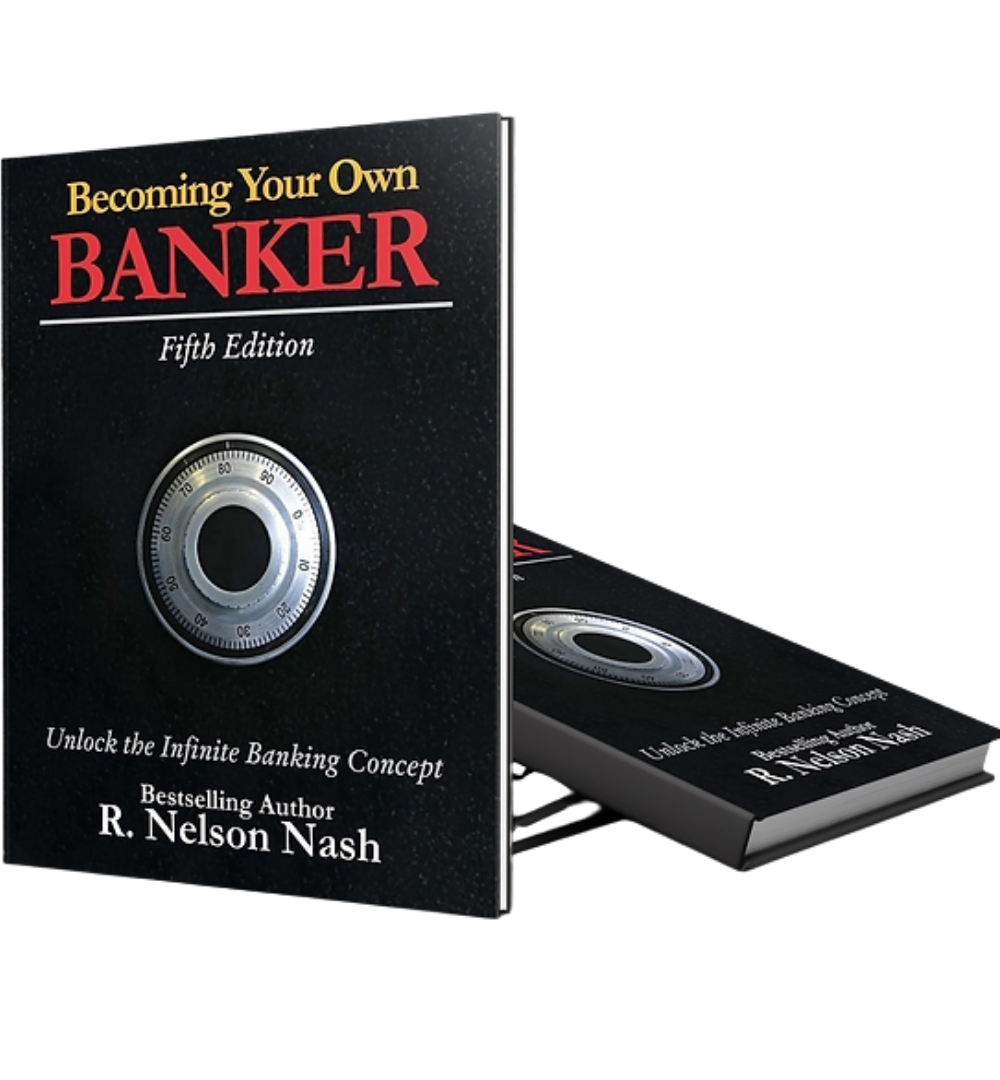

READ THE BOOK THAT STARTED THE MOVEMENT

COMPANY
LEGAL
SOCIALS
Copyright 2026. Bank On Freedom. All Rights Reserved.